- Introduction
- Why Thai Ingredients Work Together
- Lemongrass
- Galangal
- Kaffir Lime Leaves
- Coriander Root
- Thai Sweet Basil
- Holy Basil
- Lemon Basil
- Bird’s Eye Chillies
- Dried Thai Chillies
- Fish Sauce
- Shrimp Paste
- Fermented Fish
- Coconut Milk
- Palm Sugar
- Tamarind
- Fresh Limes
- Green Papaya
- Thai Eggplants
- Banana Blossom
- Morning Glory
- Thai Long Beans
- Thai Mushrooms
- Jasmine Rice
- Glutinous Rice
- Rice Noodles
- Fresh Curry Paste
- Dried Spices In Thai Cuisine
- Substituting Thai Ingredients
- Building A Basic Thai Pantry
- Storing Thai Ingredients
- Common Mistakes To Avoid
- Conclusion
- FAQ
- What Are The Most Important Unique Thai Ingredients?
- What Makes Thai Food Taste Different?
- Is Galangal The Same As Ginger?
- What Is The Difference Between Thai Basil And Holy Basil?
- Why Is Fish Sauce Used In Thai Cooking?
- Is Shrimp Paste Used In Every Thai Curry?
- Can Palm Sugar Be Replaced With Brown Sugar?
- What Gives Thai Food Its Sour Flavour?
- Where Can I Buy Thai Ingredients?
- Do I Need Every Thai Ingredient To Start Cooking?
Introduction
Thai food is recognised around the world for its bold aromas, contrasting textures, colourful presentation, and careful balance of salty, sour, sweet, spicy, bitter, and rich flavours. These qualities come from the skilful combination of fresh herbs, roots, vegetables, fruit, sauces, fermented seasonings, and pantry staples.
The unique Thai ingredients used in a dish are rarely expected to work alone. Lemongrass may provide fragrance, lime may bring acidity, fish sauce may add saltiness, palm sugar may soften sharp flavours, and chilli may create heat. Together, these ingredients produce the layered character associated with Thai cooking.
Many ingredients used in Thailand are also found elsewhere in Southeast Asia. What makes Thai cuisine distinctive is how they are prepared, balanced, and combined. A cook may pound herbs into curry paste, bruise aromatics for soup, tear fresh leaves into curry, or finish a salad with lime juice immediately before serving.
This guide introduces the unique Thai ingredients that define traditional soups, curries, salads, stir-fries, grilled dishes, snacks, and desserts. It also explains their flavour, preparation, storage, and possible substitutions.
👉 “Readers who enjoy practical cooking inspiration can also visit the GinAroy home cooking channel for easy Thai recipes, healthy meal ideas, and everyday cooking videos.”
Why Thai Ingredients Work Together
Thai cooking often creates several flavour sensations within the same dish.
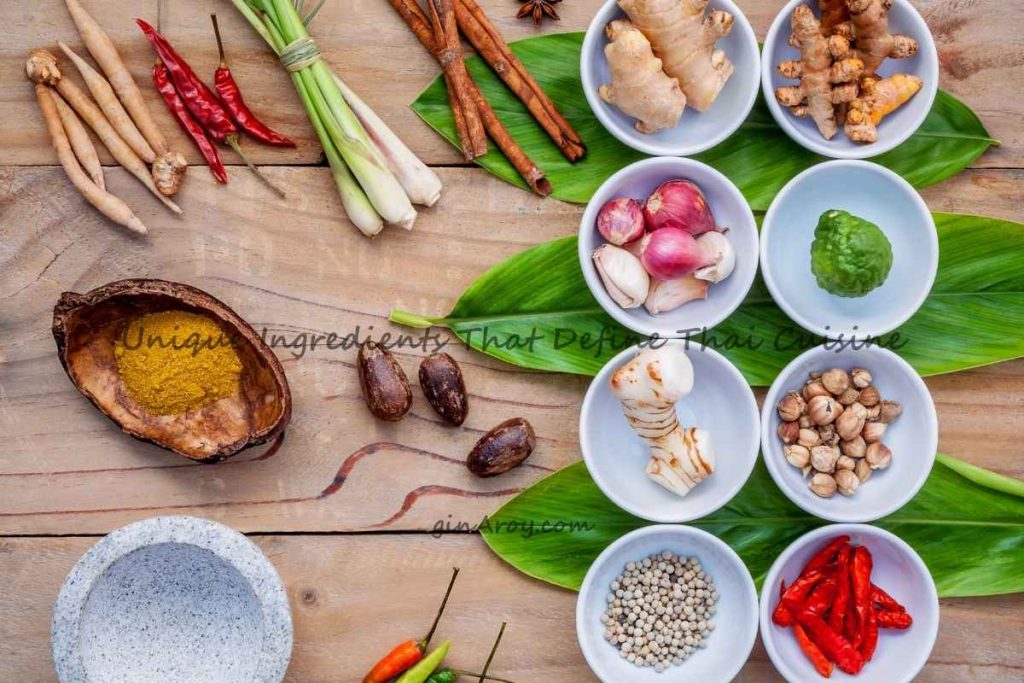
A typical recipe may include:
- Saltiness from fish sauce
- Sourness from lime or tamarind
- Sweetness from palm sugar
- Heat from chilli
- Richness from coconut milk
- Freshness from herbs
- Savoury depth from shrimp paste
- Texture from vegetables, nuts, or fried garnishes
The unique Thai ingredients in a recipe must be adjusted according to one another. Adding more fish sauce may require a little more lime or sugar. A rich coconut curry may need fresh basil or kaffir lime leaves to stop it from feeling too heavy.
This process is why tasting during cooking is so important. Recipes provide a starting point, but the strength of fresh lime, chilli, herbs, and fermented sauces can vary.
Lemongrass
Lemongrass, called takhrai in Thai, is one of the most recognisable herbs in Thai cuisine. It has a fresh citrus-like aroma without the sharp acidity of lemon or lime juice.
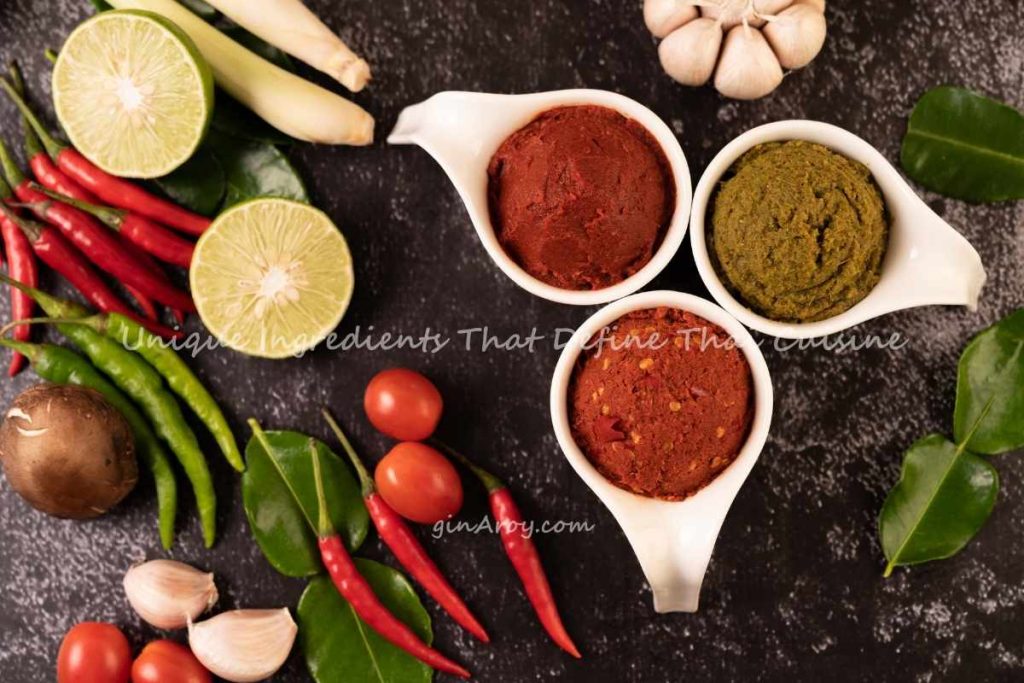
It is commonly used in:
- Tom yum
- Tom kha
- Curry pastes
- Marinades
- Seafood dishes
- Spicy salads
- Herbal drinks
For soup, the stalk is usually bruised and cut into larger pieces. These pieces release fragrance but normally remain too fibrous to eat.
For curry paste or salad, the tender lower section is sliced very finely.
Among unique Thai ingredients, lemongrass is especially valuable because it can make rich, spicy, or savoury dishes feel fresher.
Galangal
Galangal, known as kha, resembles ginger but has a firmer texture and a sharper, more peppery aroma.
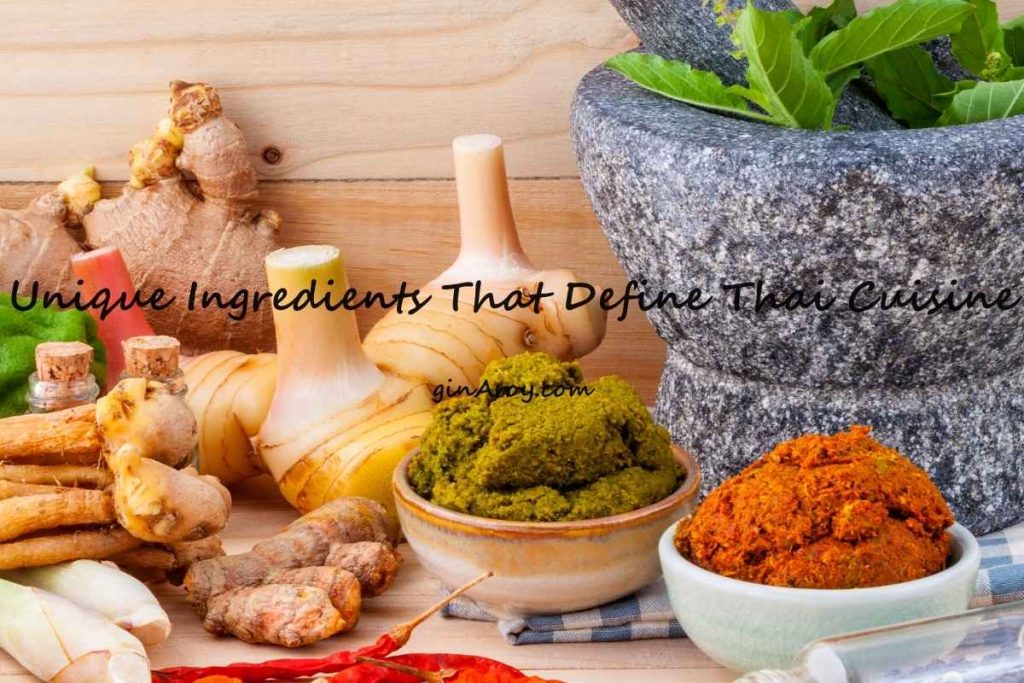
It is essential in tom kha, where its name is part of the dish. It also appears in tom yum, curry pastes, broths, marinades, and seafood preparations.
Galangal may be:
- Thinly sliced
- Bruised
- Finely chopped
- Pounded into curry paste
- Simmered in broth
Large slices are often moved aside while eating because they remain tough.
Galangal is one of the unique Thai ingredients that cannot be perfectly replaced by ginger. Ginger can provide warmth, but it does not reproduce galangal’s citrus-like and slightly resinous character.
Kaffir Lime Leaves
Kaffir lime leaves, also called makrut lime leaves, provide a strong citrus fragrance.
They are commonly:
- Torn into soups
- Added to curries
- Sliced finely into salads
- Fried as a garnish
- Pounded into curry paste
- Added to herbal drinks
The leaves often grow as two connected sections. Their thick central stem can be removed when they are sliced for eating.
A few fresh leaves can transform a curry or soup. Their intense aroma makes them some of the most powerful unique Thai ingredients in the kitchen.
Frozen leaves are usually a better substitute than dried leaves because they retain more fragrance.
Coriander Root
Coriander leaves are used in many cuisines, but Thai cooks also value the root.
Coriander root has a deeper, earthier aroma than the leaves. It is commonly pounded with garlic and white pepper to create a traditional seasoning base.
This mixture may be used for:
- Grilled chicken
- Fried pork
- Clear soup
- Marinades
- Meatballs
- Steamed dishes
- Fried garlic mixtures
Coriander root is one of the unique Thai ingredients that can be difficult to find outside Thailand. When the root is unavailable, coriander stems may provide a practical, though imperfect, substitute.
Thai Sweet Basil
Thai sweet basil, known as horapha, has a sweet aroma with notes sometimes compared with anise.
It is commonly added to:
- Green curry
- Red curry
- Noodle dishes
- Soups
- Stir-fries
- Fresh herb plates
The leaves are normally added near the end of cooking so they wilt while retaining some fragrance.
Thai sweet basil is different from common European basil. The stems may have a purple colour, and the flavour is generally stronger and more distinctive.
Its fragrance helps explain why fresh herbs are among the most important unique Thai ingredients.
Holy Basil
Holy basil, called kaphrao, is the defining herb in pad kaphrao. It has a more peppery and slightly clove-like aroma than Thai sweet basil.
It is commonly stir-fried with:
- Minced pork
- Chicken
- Beef
- Seafood
- Tofu
- Garlic
- Fresh chillies
Holy basil should be added near the end because prolonged cooking weakens its aroma.
Pad kaphrao made with ordinary sweet basil can still be enjoyable, but it will not taste the same. The use of true holy basil shows how individual unique Thai ingredients define the identity of particular dishes.
Lemon Basil
Lemon basil, known as maenglak, has a softer citrus fragrance.
It may be served with:
- Khanom jeen noodles
- Curries
- Soups
- Northern dishes
- Fresh vegetable plates
Its small dark seeds can also be soaked in water. They develop a gel-like coating and are used in some drinks and desserts.
Lemon basil demonstrates how Thai cuisine uses different varieties of the same herb family for separate purposes.
Bird’s Eye Chillies
Thai bird’s eye chillies are small but can be extremely hot. They are commonly known as phrik khi nu.
They may be:
- Crushed into dipping sauces
- Pounded into curry paste
- Added to som tam
- Sliced into fish sauce
- Stir-fried with garlic
- Added to soup
- Served raw
Chilli contributes more than heat. Fresh varieties can also provide grassy, fruity, or slightly sweet flavours.
Bird’s eye chillies are famous unique Thai ingredients, but Thai food does not need to be painfully spicy. The amount should be adjusted according to the dish and the people eating it.
Dried Thai Chillies
Dried chillies provide a deeper and sometimes smokier flavour than fresh chillies.
They are frequently:
- Soaked
- Deseeded
- Pounded into curry paste
- Fried in oil
- Crushed into flakes
- Added to soups
- Used in dipping sauces
Red curry paste and panang curry paste often depend on dried chillies for their colour and flavour.
Fresh and dried chillies are not always interchangeable. Their different characteristics give Thai cooks more control over heat, colour, and aroma.
Fish Sauce
Fish sauce, known as nam pla, is one of the main salty seasonings in Thai cuisine. It is produced through the fermentation of fish with salt.
It may be used in:
- Curries
- Soups
- Stir-fries
- Salads
- Marinades
- Dipping sauces
- Noodle dishes
Fish sauce provides saltiness and savoury depth. It is often balanced with lime juice, chilli, garlic, or palm sugar.
Among essential unique Thai ingredients, fish sauce is one of the most widely used. However, it is concentrated and can make food excessively salty when added without measuring or tasting.
Vegetarian alternatives are available, but they may create a somewhat different flavour.
Shrimp Paste
Shrimp paste, called kapi, is a fermented seasoning with a powerful aroma and concentrated savoury flavour.
It is commonly used in:
- Curry pastes
- Nam prik dipping sauces
- Fried rice
- Relishes
- Regional dishes
- Grilled preparations
Only a small amount may be needed.
Shrimp paste can be roasted or heated before use, depending on the recipe. This can deepen its aroma and make it easier to combine with other ingredients.
It is one of the unique Thai ingredients that may surprise first-time cooks because its uncooked smell can be strong. Once incorporated correctly, it gives curry paste and dipping sauce greater depth.
People with shellfish allergies must avoid shrimp paste.
Fermented Fish
Fermented fish products are especially important in regional cooking, including northeastern Thai cuisine.
Pla ra is a strongly flavoured fermented fish seasoning frequently used in:
- Som tam
- Dipping sauces
- Soups
- Regional relishes
- Isan dishes
Its flavour is more intense than ordinary fish sauce.
Pla ra is one of the regional unique Thai ingredients that demonstrates how Thai food varies across the country. A central Thai version of a dish may taste very different from an Isan preparation using fermented fish.
Properly prepared and commercially regulated products are safer choices than unidentified homemade products.
Coconut Milk
Coconut milk creates richness in curries, soups, sauces, drinks, and desserts.
Traditionally, it is made by grating mature coconut flesh and pressing it with water. The first pressing is thicker, while later pressings produce a lighter milk.
Coconut milk is used in:
- Green curry
- Red curry
- Massaman curry
- Tom kha
- Coconut sticky rice
- Custards
- Sweet soups
- Curry sauces
It is one of the best-known unique Thai ingredients, although coconut is used throughout Southeast Asia and other tropical regions.
Thai cooks often balance its richness with chilli, herbs, fish sauce, tamarind, or lime leaves.
Palm Sugar
Palm sugar has a caramel-like sweetness that can feel softer and more rounded than ordinary white sugar.
It may be sold as:
- Firm blocks
- Small discs
- Soft paste
- Granulated sugar
Palm sugar is used in:
- Curry
- Som tam
- Pad Thai
- Dipping sauces
- Marinades
- Coconut desserts
- Sticky rice sweets
Its role is often to balance sourness, saltiness, or chilli rather than make a dish obviously sweet.
Palm sugar is one of the unique Thai ingredients that helps produce balance. However, it is still added sugar and should be used thoughtfully.
Tamarind
Tamarind provides a deep, fruity sourness that differs from fresh lime.
Tamarind pulp or paste is used in:
- Pad Thai
- Sour curries
- Dipping sauces
- Fish dishes
- Tamarind prawns
- Herbal drinks
- Desserts
To prepare tamarind pulp, it may be soaked in warm water, squeezed, and strained.
Tamarind is especially useful in cooked dishes because its flavour holds up better under heat than fresh lime juice.
The contrast between tamarind and lime shows how unique Thai ingredients can provide different types of sourness.
Fresh Limes
Fresh lime juice creates a bright and sharp sour flavour.
It is essential in:
- Tom yum
- Som tam
- Larb
- Seafood salad
- Nam jim
- Grilled meat dressings
- Spicy noodle salads
Lime juice is often added near the end of cooking or after the heat is turned down. Long boiling can weaken its fresh character.
Fresh lime is among the simplest but most important unique Thai ingredients because it can immediately brighten a salty, spicy, or rich dish.
Green Papaya
Green papaya is the unripe form of the familiar tropical fruit. Instead of being soft and sweet, it is firm, pale, and relatively neutral in flavour.
It is best known as the main ingredient in som tam.
The shredded papaya absorbs a dressing made from ingredients such as:
- Lime
- Fish sauce
- Palm sugar
- Garlic
- Chilli
- Tomato
- Long beans
Its crunchy texture is essential to the dish.
Green papaya is one of the unique Thai ingredients that demonstrates how different stages of ripeness can produce completely different culinary uses.
Thai Eggplants
Thai cooking uses several eggplant varieties.
These include:
- Round green eggplants
- Pea eggplants
- Long purple eggplants
- White eggplants
- Striped varieties
Round Thai eggplants are commonly quartered and added to curries. They absorb sauce while retaining some firmness.
Pea eggplants are very small and slightly bitter. They are often added in clusters to green curry or regional dishes.
These vegetables are distinctive unique Thai ingredients because their texture and mild bitterness balance rich coconut-based sauces.
Banana Blossom
Banana blossom is the large purple flower that grows at the end of a banana cluster.
It can be:
- Thinly sliced into salad
- Served with noodles
- Added to curry
- Cooked in coconut milk
- Used in vegetarian dishes
- Served beside pad Thai
The outer layers are removed to reach the tender inner sections.
Cut banana blossom can darken quickly, so it is often placed in water with lime or another acidic ingredient.
Its texture makes it one of the more unusual unique Thai ingredients for international cooks.
Morning Glory
Morning glory, also called water spinach, is a popular leafy vegetable in Thailand.
It is commonly stir-fried quickly with:
- Garlic
- Chilli
- Soybean paste
- Oyster sauce
- Fish sauce
- Sugar
The stems remain slightly crisp while the leaves wilt.
Morning glory is affordable, fast-cooking, and widely available in Thai markets. Its popularity shows that unique Thai ingredients do not need to be rare or expensive.
Thai Long Beans
Thai long beans are longer and firmer than many common green beans.
They are used in:
- Som tam
- Stir-fries
- Curries
- Fresh vegetable plates
- Spicy salads
In som tam, the beans may be cut into short pieces and lightly bruised so they absorb the dressing while remaining crunchy.
Their firm texture makes them especially useful in dishes where vegetables are not cooked for long.
Thai Mushrooms
Several mushroom varieties appear in Thai food, including:
- Straw mushrooms
- Oyster mushrooms
- Wood ear mushrooms
- Shiitake mushrooms
- Enoki mushrooms
- Shimeji mushrooms
Straw mushrooms are particularly familiar in tom yum. Oyster mushrooms work well in vegetarian soups and curries.
Mushrooms absorb broth and sauce, making them useful in both meat-based and plant-based dishes.
Although they are not exclusive to Thailand, they work naturally with other unique Thai ingredients such as lemongrass, galangal, chilli, and coconut milk.
Jasmine Rice
Jasmine rice is the main accompaniment to many central Thai dishes. It has long grains and a naturally fragrant aroma.
It is served with:
- Curries
- Stir-fries
- Soups
- Grilled meat
- Fried eggs
- Dipping sauces
- Shared family meals
Rice provides a calm base for strong, salty, spicy, or sour foods.
Thai jasmine rice is not simply a side dish. It is a central part of the meal and helps balance the intensity of other unique Thai ingredients.
Glutinous Rice
Glutinous rice, also called sticky rice, is especially important in northern and northeastern Thailand.
It is traditionally soaked, steamed, and eaten by hand in small portions.
Sticky rice may accompany:
- Grilled chicken
- Larb
- Som tam
- Nam prik
- Isan sausages
- Grilled meat
It is also used in desserts such as mango sticky rice.
The contrast between jasmine rice and sticky rice reflects Thailand’s regional food traditions.
Rice Noodles
Thai cuisine uses several rice-noodle shapes and sizes.
These include:
- Thin rice vermicelli
- Medium noodles
- Wide noodles
- Fresh rice sheets
- Fermented rice noodles
They appear in:
- Pad Thai
- Pad see ew
- Boat noodles
- Rad na
- Khanom jeen
- Noodle soups
The noodle chosen affects texture, sauce absorption, and cooking time.
Rice noodles combine with unique Thai ingredients such as tamarind, fish sauce, chilli, basil, curry, and fresh vegetables to produce many distinct dishes.
Fresh Curry Paste
Curry paste brings several ingredients together into one concentrated base.
A traditional paste may contain:
- Chillies
- Lemongrass
- Galangal
- Kaffir lime peel
- Coriander root
- Garlic
- Shallots
- Spices
- Shrimp paste
- Salt
Pounding the ingredients breaks down fibres and releases aromatic oils.
Different pastes create green curry, red curry, panang curry, massaman curry, jungle curry, and other dishes.
Curry paste may be the clearest example of how unique Thai ingredients are combined to produce a unified flavour greater than any single component.
Dried Spices In Thai Cuisine
Fresh herbs receive much attention, but dried spices are also important.
Thai recipes may use:
- Coriander seeds
- Cumin
- White pepper
- Black pepper
- Cinnamon
- Star anise
- Cardamom
- Cloves
These spices are particularly important in massaman curry, some marinades, soups, and Chinese-influenced Thai dishes.
The combination of fresh aromatics and dried spices gives Thai food additional complexity.
Substituting Thai Ingredients
Some ingredients can be difficult to find outside Thailand.
Possible substitutions include:
- Frozen galangal for fresh galangal
- Frozen kaffir lime leaves for fresh leaves
- Coriander stems for coriander root
- Regular eggplant for Thai eggplant
- Brown sugar for palm sugar
- Tamarind concentrate for prepared pulp
- Regular basil when Thai basil is unavailable
Substitutions make cooking more practical, but they can change the final flavour.
Understanding the role of unique Thai ingredients helps cooks choose a replacement. A substitute should perform a similar function, such as adding sourness, fragrance, sweetness, or texture.
Building A Basic Thai Pantry
A useful beginner pantry could include:
- Fish sauce
- Soy sauce
- Tamarind paste
- Palm sugar
- Coconut milk
- Jasmine rice
- Rice noodles
- Dried chillies
- Curry paste
- Shrimp paste when suitable
Fresh additions might include:
- Lemongrass
- Galangal
- Kaffir lime leaves
- Garlic
- Shallots
- Fresh chillies
- Thai basil
- Limes
- Coriander
With these unique Thai ingredients, home cooks can prepare soups, curries, stir-fries, salads, noodle dishes, and dipping sauces.
Storing Thai Ingredients
Fresh herbs and vegetables need careful storage, particularly in warm climates.
Helpful methods include:
- Keep herbs reasonably dry
- Refrigerate fresh leaves
- Wrap herbs loosely in paper
- Freeze lemongrass and galangal
- Freeze kaffir lime leaves
- Keep curry paste covered and refrigerated
- Store dried spices away from heat
- Seal fish sauce and soy sauce properly
- Refrigerate opened coconut milk
- Keep palm sugar protected from moisture
Proper storage preserves aroma and reduces waste.
Fresh unique Thai ingredients should be checked regularly and discarded when they become mouldy, slimy, or unpleasant-smelling.
Common Mistakes To Avoid
Avoid these common mistakes:
- Assuming Thai food is only about chilli
- Confusing ginger with galangal
- Using every basil variety interchangeably
- Boiling fresh lime juice too long
- Adding too much fish sauce
- Using excessive palm sugar
- Eating large fibrous herb pieces
- Failing to slice lemongrass finely
- Using spoiled coconut milk
- Forgetting shellfish in shrimp paste
- Replacing every fresh ingredient with powder
- Overcooking Thai eggplants
- Ignoring regional variations
- Expecting one curry paste to suit every curry
Learning the role of each ingredient makes Thai cooking more predictable and enjoyable.
👉 “Readers interested in the ingredients that shape Thai cuisine may also explore how fresh ingredients are used in traditional Thai cooking for more insight into flavor, balance, and preparation.”
Conclusion
The unique Thai ingredients used in traditional cooking create a cuisine filled with fragrance, contrast, texture, and balance.
Lemongrass, galangal, kaffir lime leaves, coriander root, Thai basil, holy basil, chillies, fish sauce, shrimp paste, coconut milk, palm sugar, tamarind, and fresh lime each contribute something different.
Vegetables such as green papaya, Thai eggplant, banana blossom, morning glory, and long beans add crunch, mild bitterness, freshness, and visual variety. Jasmine rice, sticky rice, and rice noodles provide the foundation for many regional meals.
What defines Thai cuisine is not one rare herb or powerful sauce. It is the way unique Thai ingredients are prepared and balanced. Sourness controls richness, sweetness softens sharpness, herbs lift savoury dishes, and rice balances intense flavours.
Begin with a small collection of reliable ingredients, taste throughout cooking, and learn which items provide aroma, saltiness, heat, acidity, richness, or texture.
With practice, the unique Thai ingredients that initially seem unfamiliar become practical tools for creating authentic and memorable Thai food at home.
FAQ
What Are The Most Important Unique Thai Ingredients?
Important ingredients include lemongrass, galangal, kaffir lime leaves, Thai basil, holy basil, fish sauce, shrimp paste, coconut milk, tamarind, palm sugar, chillies, and coriander root.
What Makes Thai Food Taste Different?
Thai food often balances salty, sour, sweet, spicy, bitter, rich, and aromatic elements within one dish. Fresh herbs and fermented seasonings add additional depth.
Is Galangal The Same As Ginger?
No. Galangal is firmer and has a sharper, more citrus-like and peppery flavour. Ginger is generally warmer and slightly sweeter.
What Is The Difference Between Thai Basil And Holy Basil?
Thai sweet basil has a sweet, anise-like aroma and is commonly used in curries. Holy basil is more peppery and defines pad kaphrao.
Why Is Fish Sauce Used In Thai Cooking?
Fish sauce adds saltiness and savoury depth. It is commonly balanced with lime, chilli, herbs, or palm sugar.
Is Shrimp Paste Used In Every Thai Curry?
No. It is used in many traditional curry pastes and dipping sauces, but recipes vary. Vegetarian and seafood-free versions may use other seasonings.
Can Palm Sugar Be Replaced With Brown Sugar?
Brown sugar can be used when palm sugar is unavailable, but it may not provide the same caramel-like flavour or texture.
What Gives Thai Food Its Sour Flavour?
Fresh lime, tamarind, sour fruit, and fermented ingredients can provide sourness. Lime gives a bright flavour, while tamarind is deeper and fruitier.
Where Can I Buy Thai Ingredients?
Look in Thai markets, Asian supermarkets, specialist food shops, farmers’ markets, and reliable online stores. Frozen herbs can be useful when fresh versions are unavailable.
Do I Need Every Thai Ingredient To Start Cooking?
No. Begin with fish sauce, coconut milk, curry paste, jasmine rice, lime, garlic, chillies, and a few fresh herbs. Add more specialised ingredients as you learn new recipes.